


NURSING CARE Graduated Compression Stockings AG Class II 23–32 mmHg – 340 DEN Without Footwear
NURSING CARE Graduated Compression Stockings AG Class II 23–32 mmHg – 340 DEN Without Footwear
Couldn't load pickup availability
Nursing Care AG Class II Graduated Compression Socks – 23–32 mmHg, 340 DEN, Open-Toe
Venous insufficiency can cause tired legs, a heavy feeling, swelling and discomfort, especially after long periods of standing or sitting.
The Nursing Care AG Class II 340 DEN Graduated Compression Socks, with therapeutic compression of 23–32 mmHg, were developed to help improve lower limb venous circulation and provide support in cases of venous insufficiency.
With an AG (thigh-high) length, these socks apply graduated compression, highest at the ankle and progressively lower towards the upper leg, promoting venous return to the heart.
The open-toe design keeps the toes free and allows for use tailored to individual needs.
Main benefits
-
Class II therapeutic compression (23–32 mmHg): provides graduated venous support for situations requiring moderate compression.
-
Helps improve venous return: promotes blood flow from the legs towards the heart.
-
Relief from the heavy feeling in the legs: helps reduce discomfort associated with venous insufficiency.
-
Helps control oedema: graduated compression can help reduce lower limb swelling.
-
Support in cases of varicose veins: indicated for people with moderate chronic venous insufficiency, under medical guidance.
-
Thigh-high length (AG): allows compression to be applied from the foot area to the upper thigh.
-
Open-toe design: keeps the toes free, providing an alternative to closed-toe compression socks.
-
Anatomical design: developed to follow the shape of the lower limbs.
-
Elastic material: a combination of polyamide and elastane to adapt to the leg.
Who are they recommended for?
Nursing Care Class II Compression Socks are recommended, following medical assessment or guidance, for people with:
-
Moderate chronic venous insufficiency, associated with varicose veins, oedema or a heavy feeling in the legs.
-
Symptomatic varicose veins, requiring support through graduated compression.
-
Moderate lower limb oedema, associated with changes in venous circulation.
-
Discomfort and a tired feeling in the legs, especially after long periods of standing or sitting.
-
Need for compression after sclerotherapy or venous surgery, as prescribed by a doctor.
-
Certain situations of superficial venous thrombosis or prevention of deep vein thrombosis, exclusively when recommended by a healthcare professional.
-
History of a healed venous ulcer, when compression is indicated to reduce the risk of recurrence.
How does graduated compression work?
Graduated compression consists of applying different levels of pressure along the leg.
In Nursing Care Class II compression socks, the pressure is highest at the ankle and decreases progressively towards the thigh.
This mechanism helps to:
-
Promote venous return.
-
Reduce venous stasis, i.e., the accumulation of blood in the legs.
-
Improve the management of venous oedema.
-
Relieve the heavy feeling and fatigue in the legs.
Class II compression, at 23–32 mmHg, is intended for situations requiring greater therapeutic support than light compression socks and should be used according to clinical guidance.
Why choose AG compression socks up to the thigh?
AG compression socks extend to the upper thigh, unlike AD models, which end below the knee.
This length allows compression to be applied over a larger area of the leg and can be particularly useful when the distribution of venous changes or oedema warrants thigh-high socks.
The choice between AD, AG or AT compression socks should be made according to the clinical situation and the recommendation of a healthcare professional.
Technical specifications
-
Brand: Nursing Care
-
Reference: MN42
-
Product: Class II Graduated Compression Socks
-
Compression: 23–32 mmHg
-
Compression class: II
-
Length: AG – Thigh-high
-
Density: 340 DEN
-
Toe area: Open (open-toe)
-
Composition: 73% polyamide and 27% elastane
-
Fit: Anatomical
-
Use: Unisex
-
Classification: Class I Medical Device
Washing and care instructions
To preserve the effectiveness of the compression and the durability of the elastic fibres:
-
Wash by hand daily in cold or lukewarm water, up to 30 °C.
-
Use neutral soap or mild detergent.
-
Do not use fabric softeners, bleach or abrasive products.
-
Do not rub or wring vigorously.
-
Remove excess water by gently pressing.
-
Dry naturally in the shade, in a well-ventilated area.
-
Do not use a washing machine, tumble dryer or direct heat sources.
-
Store the socks clean and completely dry.
Nursing Care – Therapeutic Compression for Leg Care
The Nursing Care AG Class II 23–32 mmHg Graduated Compression Socks combine therapeutic support, elasticity and anatomical fit to help control symptoms associated with venous insufficiency.
At Neovida, you will find specialised graduated compression solutions for lower limb care and comfort.
Choose the compression appropriate for your needs and take care of your leg health.
Note: The use of Class II compression socks should follow the guidance of a healthcare professional. Selecting the correct size and assessing possible contraindications are essential for proper use.
What are Class II compression socks used for?
Class II compression socks apply graduated pressure to the lower limbs, helping to improve venous return, reduce oedema and relieve symptoms such as heavy legs and discomfort associated with venous insufficiency.
What does 23–32 mmHg compression mean?
It means that the sock applies graduated therapeutic pressure, with reference values of 23 to 32 millimetres of mercury at the ankle. This pressure decreases progressively towards the upper leg.
What is the difference between Class I and Class II compression socks?
Class I corresponds to lower levels of compression, while Class II provides higher compression, used in certain situations involving venous insufficiency, varicose veins and oedema. The values for each class depend on the classification standard adopted.
What does AG mean in compression socks?
AG identifies a thigh-high compression sock. Unlike AD socks, which end below the knee, AG socks cover a greater length of the lower limbs.
Are Nursing Care Class II socks recommended for varicose veins?
Yes. They may be recommended for people with varicose veins and moderate chronic venous insufficiency, under medical guidance. Graduated compression helps improve venous return and relieve associated symptoms.
Do compression socks help reduce leg swelling?
Yes. When oedema is related to venous circulation problems, graduated compression can help reduce fluid accumulation and improve leg comfort.
What is the advantage of open-toe compression socks?
Open-toe socks leave the toes free, providing an alternative to compression socks with a closed toe area. The choice depends on comfort and individual needs.
Can I wear Class II compression socks all day?
The period of use should follow the healthcare professional's recommendation. In many situations, they are worn during the day and removed before going to bed, unless otherwise clinically indicated.
Can I sleep with Class II compression socks on?
It is not recommended to sleep with therapeutic compression socks on without a specific indication from a healthcare professional.
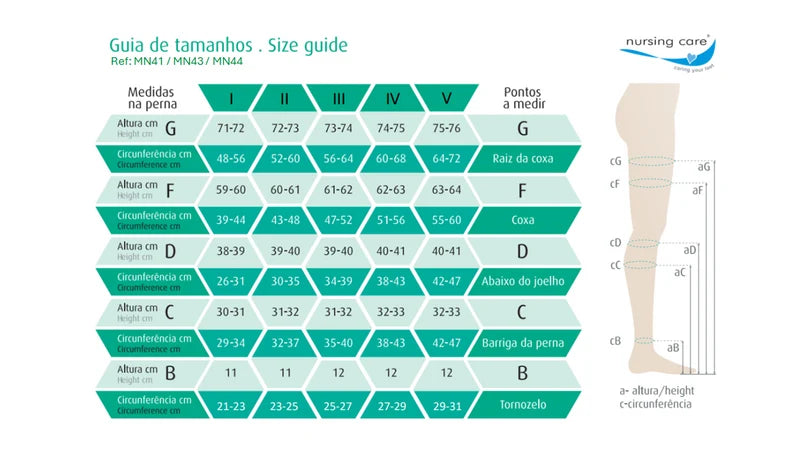
How do I choose the correct size for thigh-high compression socks?
The size should be chosen based on the measurements indicated in the manufacturer's guide, including leg circumferences and length. It is advisable to take the measurements in the morning, when oedema tends to be lower.
Can compression socks be worn during pregnancy?
They may be recommended in certain situations involving varicose veins or venous changes associated with pregnancy, but the compression class and model must be determined by a healthcare professional.
How do I wash Nursing Care compression socks?
They should be washed by hand daily, in water up to 30 °C and with mild detergent. They should not be twisted or put in a washing machine or tumble dryer.
What is the difference between 340 DEN and 23–32 mmHg?
The 340 DEN indicates a characteristic related to the linear density of the yarn used in the sock. The 23–32 mmHg indicates the therapeutic compression pressure. They are different measurements and should not be confused.

-

Free Shipping
Free shipping to mainland Portugal on orders over €49.99
-

Returns
Free returns within 30 days of purchase
-

Customer Support
Customer support 8 hours/day: Telephone, Whatsapp, Email
-

Secure Payment
100% secure payment methods
